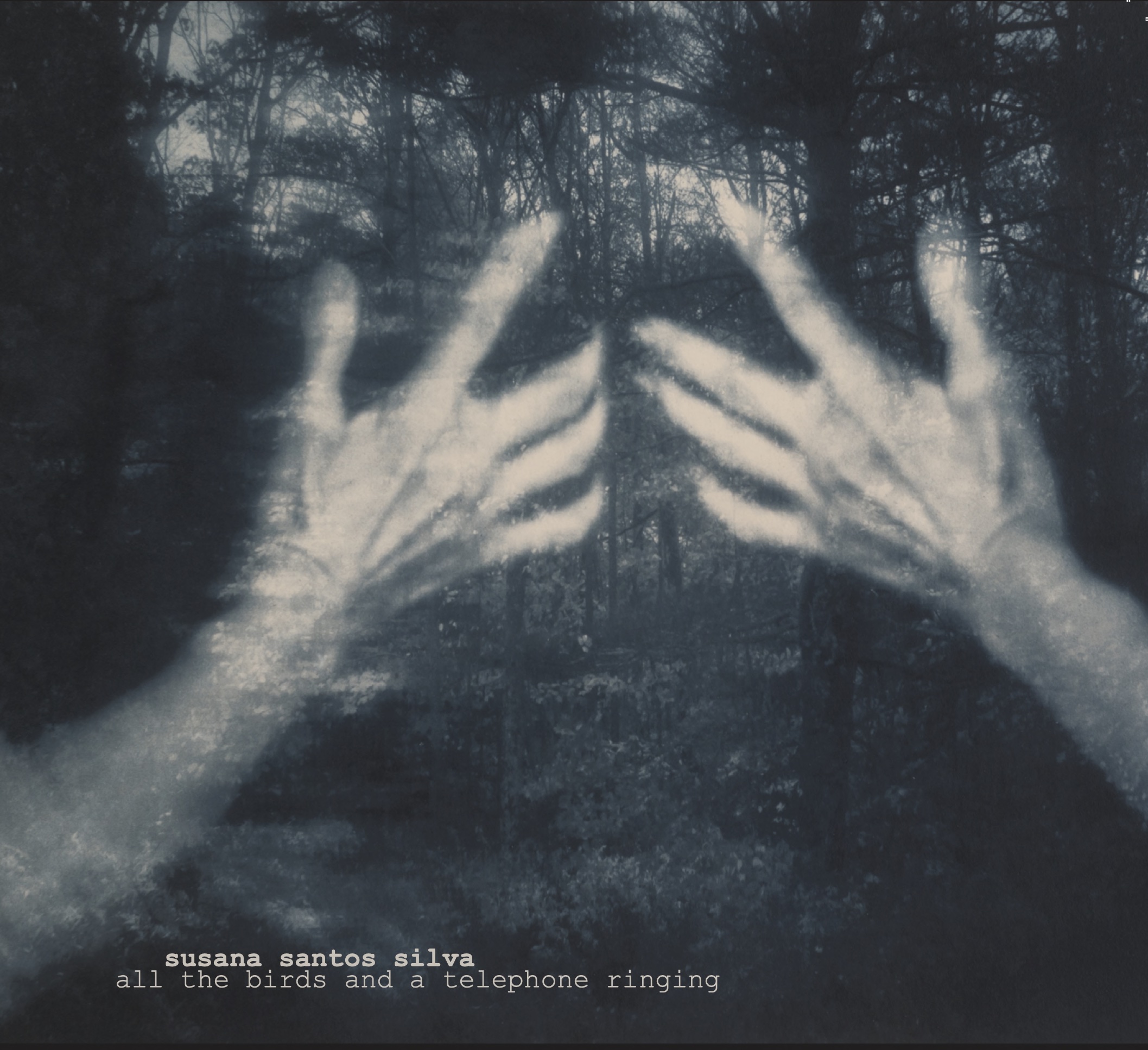
what a magical thing to be able to contemplate the world!
your eyes become one with what you see. your breath merges with the breath of the wind. your skin is not anymore your skin but the skin of what you touch. what you hear is what you are. i breath in what is there and when i breath out i give myself as I am.
.
.
REVIEWS
The Sound Projector
Coming from a background of avantgarde jazz and improvisation, Portuguese-born trumpeter Susana Santos Silva adds field recordings and electronics to her toolkit in recording her most recent album “All the Birds and a Telephone Ringing”. The unusual juxtaposition of the natural world and the anthropomorphic world of modern mass media technologies in the album’s title hint at the uneasy relationships and tensions that often exist between nature and humans, with nature often being the more adversely affected of the two … but then, as we’re only too well aware, nature ends up being the one that bats last. Just as unusual too is the way in which Santos Silva combines field recordings with her trumpet sounds, such that it’s the field recordings that constitute the music and the trumpet or other sounds coming from conventional musical instruments that act like effects or background noises. This is apparent on first track “The Way Home”, in which the hull of a creaky wooden ship provides the structure and pace of the music, the bleating of seagulls adds a sort of melody, and the trumpet and percussion instruments become incidental sound effects.
After this introduction, the album switches from more conventionally melodic though still free jazz (“Always Arriving Always Departing”) to musique concrete (“As One Comes to the World”) to noise ambient (“All the Birds”). Each song is very consistent in its entirety and each song also represents a different fusion of field recording samples, trumpet, flute and studio processing techniques. Each time a new song starts then, can come as a complete surprise to those who think they can pin down Santos Silva’s style and approach to music composition and performance into a neat box with as few words to describe her music-making as possible. Some listeners may find the long tracks a bit tiresome – over seven or nine minutes, long pieces like “As One Comes to the World” and “All the Birds” seem to get stuck in ruts of their own making and repeating themselves over and over – and though these songs are embellished with plenty of background samples of everyday life, they can appear detached from the storm and stress of daily living. Only the final track “For Reasons a Human Cannot Divine” admits some melancholy mood and gloom in Santos Silva’s trumpet playing.
This is an intriguing if rather minimalist work with inspired use of field recordings in their own right as though they are actual musical elements. A couple of tracks could be a bit longer to exercise their ability to draw in and swallow up listeners and guide them gently through an immersive soundscape. As a limited edition cassette release, this album might become something of a collector’s item among lovers of experimental and free jazz in the near future.
WIndout
We’re literally captivated by the purposeful force of this work that resonates in a familiar way yet emits an enveloping aura of jazz mystery, with a raw and deep dreamy quality. Field recordings overlap to form a free magma of matter evolving through floating landscapes between urbanity and the organic universe, Simply sublime Susana Santos Silva (trumpet, improviser and composer) her visual and composer) and experimental electronics ignites everything: it can disrupt you, but it perverse across the globe with his dazzling and fascinating proposal. Portuguese trumpeter Susana Santos Silva has firmly established herself in the high realms of jazz and improvisational music, a musician with lyrical imagination and technical ferocity. Her assertive voice, as a versatile improviser, is expanded here, fantastically combined with other resources to explore in new ways the nature of African American sounds. A mature and versatile album.
Siamo letteralmente catturati dalla forza propositiva di quest’opera che risuona in modo familiare eppure emana un’aura di mistero jazz avvolgente, con una qualità onirica cruda e profonda. Le registrazioni sul campo si sovrappongono per dare forma a un magma free di materia in evoluzione attraverso paesaggi fluttuanti tra urbanità e universo organico, Semplicemente sublime Susana Santos Silva (trumpet, improviser and composer) la sua elettronica visiva e sperimentale accende tutto: sa distrurbarti, ma inperversa in tutto il globo con la sua proposta sbilenca e affascinante. La trombettista portoghese Susana Santos Silva si è saldamente affermata nelle alte sfere del jazz e della musica improvvisata, una musicista di immaginazione lirica e ferocia tecnica. La sua voce affermata, come improvvisatrice versatile, viene qui ampliata, combinata in modo fantasioso con altre risorse per esplorare in modi nuovi la natura dei suoni afroamericani. Un album colto e versatile.
The Arts Desk
Similarly Susana Santos Silva’s All the Birds and a Telephone Ringing on Thanatosis says on the back that it was made “with support from the Swedish Arts Council”. This sounds about right as the album by the trumpet-player/composer of that nation submerges her instrument, when it’s there at all, beneath a range of found sounds, watery burbles, and creaky swings, ending up with music that is close in spirit to the original late 1940s Musique Concrète work which Jean-Michel Jarre also pays tribute to on his latest album, reviewed above.
Citizen Jazz
all the birds and a telephone ringing est le dernier projet personnel de la trompettiste qui travaille depuis plusieurs années maintenant dans le domaine de l’électro-acoustique, que ce soit dans le cadre de recherches universitaires ou de pratique.
Avec cet enregistrement, la musicienne propose une promenade dans un univers sonore, fait en grande partie de field recordings et de quelques interventions plus acoustiques. C’est comme un film qui se déroule dans la tête de l’auditeur, avec des indices et repères connus, d’autres moins, qui permettent d’inventer nos propres images.
Aussi déroutant qu’entêtant, ce disque ne dévoile pourtant qu’un dixième du talent de conteuse de la trompettiste.
Free Jazz Blog
Whether with her work in Fire! Orchestra, Gustafsson’s NU Ensemble, Hearth, her countless collaborations or as bandleader with her quintet and Impermanence, trumpeter and composer Susana Santos Silva seems to somehow always be involved in a lot of my favourite contemporary music lately.
It was with the release of her wonderful album “All The Rivers” that I started to really pay attention to her solo career, captivated by her lyrical, inspired and inspiring improvisations reverberating throughout Portugal’s Panteão Nacional. An album where the environment she performs in plays as big a role as the notes coming out of her instrument, a fascination with her surroundings that I feel foreshadows some of the ideas she completely embraced on this new offering.
This album is a tactile, visceral tapestry of samples and field recordings accompanied (but not always) by all the different sounds she’s able to bring out of her instrument. I despise the word “cinematic” in music reviews, so, since I almost caved to the temptation of using it, I’ll settle with saying that this album feels like flipping through a very personal diary, just managing to glimpse at a few excerpts of what’s written on it as you turn the pages. It tells a story, but it’s fragmented, and though you can’t quite piece it together you can definitely feel its emotional impact.
It’s amazing just how a few sound cues can instantly transport the listener to different places and times: “The Way Home“, for instance, with just a few samples of creaking wood, squeaking metal and the distant sound of waves crashing put the listener on a ship swaying in the wind, Santos Silva is removed from the scene, her trumpet just a foghorn in the distance.
The people recorded at a train station on “Always Arriving” go about their daily business, their chores, their travels without having any idea that a ghostly trumpet is echoing around the platforms, halls and tunnels of the station; Santos Silva is never the center of the pictures she paints on the album. Often separated, her playing almost always feels overdubbed (at least to me) after the fact. This means that this album is much more than environmental improvisations: overdubbing allows for more possibilities, both storytelling and music-wise, and maintains the “purity” of the field recordings as there’s no risk that they be influenced by her presence. The samples aren’t a gimmick and aren’t window dressing, they’re as important as the playing and it’s they that anchor the listener to the places the music takes them. This is just speculation on my part as I can’t know for sure that the playing is overdubbed, but this is what makes the most sense to me.
The only piece that radically deviates from this ethos is “As One Comes to the World“, consisting of 9 minutes of Santos Silva playing her trumpet with its bell underwater, expanding her sonic palette not with samples but with the direct interaction of the instrument and the environment foreshadowed by her past work, that here reaches its logical conclusion: pure symbiosis.
“All the Birds” sounds like childhood: its gorgeous and warm drone hums along something very similar to the sound of a VHS rewinding (that I suspect might actually be Santos Silva on her trumpet), lulling the listener into a stupor for a few minutes until the drone is stripped away, leaving nothing but the distant chirping of birds and Santos Silva’s understated playing, short breaths and squeals trying to imitate the noises coming from above.
“And a Telephone Ringing” is the sound of living in a city (or in my personal journey through the album, the sound of adulthood). Noises recorded in what seems to be an apartment block’s stairwell, maybe an atrium or a patio, of people going by as Santos Silva’s frenzied Irish flute plays the part of an ever-ringing telephone that nobody but the listener can hear and that nobody will ever pick up. This is an example of the importance of keeping the music and the field recordings separate that I alluded to earlier: had she been playing the flute in that apartment block at the time of recording the people might have stopped by to listen to the music, interacting with it and interrupting their daily routines, and the piece wouldn’t have been able to tell the same story it tells now.
The album ends with “For Reasons a Human Cannot Divine“, my favourite piece and the most lonesome. Santos Silva’s lyrical playing I loved so much on “All the Rivers” is back, this time not accompanied by the echoes of the Panteão Nacional but rather alone in a field. You can almost feel the grass move in the wind while the birds sing above. The playing is commanding but relaxed, perfectly in sync with the sounds of nature around it. Rain starts to fall, thunder cracks, man-made noises (trains, cars, heavy machinery) begin to approach as the playing becomes more and more urgent, but in the end it all ultimately dies down, leaving nothing but the birds’ singing (and maybe a telephone ringing).
By its nature, this is an album with countless possible interpretations and your experience with it and its “wordless storytelling” will surely differ from mine, but if you allow it to transport you to its meticulously painted vignettes you’ll be able to write your own story that I’m sure will be as emotionally rewarding as it was for me. It’s a special and personal release, yet another high mark and turning point for the career of this rising star of the free improvisation scene. Santos Silva’s music is alive, ever-versatile and with innumerable possibilities ahead. I’ll be listening closely and I suggest you do the same.
Silence And Sound
With All The Birds And A Telephone Ringing, she offers an album of hypnotic strangeness built with shots of field recordings and mixed textures, bewitching breaths and naturalistic atmospheres.
We are literally captivated by the force of proposal of this opus resonating in a familiar way and yet giving off an aura of enveloping mystery, with a raw and deep dreamlike quality.
Field recordings are superimposed to give shape to a magma of matter evolving through landscapes fluctuating between urbanity and organic universe, concentrated life in continuous movements. Fascinating!
Music Map
Among birds, alarms of moving machinery, and not immediately recognizable noises, trumpeter Susana Santos Silva immerses us in a curious work of field recording. Following John Cage’s philosophy, according to which every sound we hear can be music (and he doesn’t distinguish between sound and noise), the Portuguese artist explores electronics, trying to get as many sounds as possible from his instruments. Trumpet, Irish flute, and precisely the environmental recordings.
The album “All the birds and a telephone ringing”, released for Thanatosis Produktion, is a collage of acoustic experiences. In “All the birds” and in “The way home” various types of chirping birds can be recognized. After that, in “Always arriving always departing”, it seems to be at the airport, among the reverberations of distant voices, and sudden alarms, as if a reversing luggage van was approaching. In all of this, Silva improvises with his faithful traveling companion, the trumpet, and seems to weave a monologue, a reflection in sounds rather than a melody. The trumpet will then return to dialogue with the storm, in the closing track “For reasons a human cannot divine”, while the trains pass on the tracks, and a bell rings.
We hear the Irish flute “chirping” in “And a telephone ringing”, among the voices of people as in offices. But the most intriguing experiment are those 9 minutes of “As one comes to the world”. Santos Silva immerses the trumpet in water, and using two hydrophones (underwater microphones), records each liquid bubbling with great definition. By improvising, Susana pays close attention to what she gets, gradually directing the variations, thus making a fascinating abstract narrative. (Gilberto Ongaro)
Salt Peanuts
All The Birds And A Telephone Ringing is the new solo album of Portuguese, Stockholm-based trumpeter Susana Santos Silva, and it marks a new direction in her musical career. Silva, who has worked with pianist Kaja Draksler, Mats Gustafsson’s Fire! Orchestra, bassist Torbjörn Zetterberg, Fred Frith and Anthony Braxton, in addition to leading several bands of her own, currently studying electro-acoustic composition at the Royal College of Music. The new album expands her sonic palette, far beyond the extended breathing techniques for the trumpet, and offers intriguing sound collages that meticulously blend field recordings, electronics and her suggestive trumpet playing that stress her interest in narrative and wordless storytelling.
The title of the album was inspired by a line in John Cage’s seminal book Silence (Cage also composed a piece, Telephones and Birds, 1977, for three performers, telephone announcements, and recordings of bird songs, originally used as music for the choreographed piece by Merce Cunningham, «Travelogue»), and Silva embraces many of Cage’s theories on sound and listening. Silva’s album is about the relationship between nature and humans, how we interact, how we affect the world around us and affected by the climate crisis. «What we hear around us is already music itself», she says.
Silva began investigating this new sonic path when she was approached in 2019 by the Belgian imprint Matière Mémoire to contribute a piece to its MMXX series to compose an electronic piece. She followed with the shape-shifting organ-drenched meditation, From The Ground Birds Are Born (Superpang, 2021). All The Birds And A Telephone Ringing was recorded and mixed by Silva in Stockholm and Porto between August and December 2021, with additional field recordings by Swedish composer-sound artist Rosanna Gunnarson and Zetterberg. Silva is complementing the album with a series of videos for each piece using footage shot with her phone, a kind of visual analog to her field recordings.
The music is intimate and still sounds spontaneous, despite the meticulous recording and mixing process and the new, experimental, explorative approach, and radiates an engaging logic of its own and an intuitive freshness. Silva attempts to find a compassionate and organic common sonic ground that would resonate the field recordings and innocent nature’s sounds with the sounds of human interventions with nature. Her trumpet playing highlights her lyrical imagination, but now becomes even more adventurous when she submerged the bell of her horn beneath the surface of the water on «As One Comes to the World», with a pair of hydrophones capturing her blobby gurgles and unpitched breaths, or converses gently with bird calls in «All The Birds» and sketches a timeless folk song in «For Reasons A human Cannot Divine». The suggestive cover art by Canadian-American visual artist Jeannie Hutchins («who uses photography to explore life’s unanswerable questions») solidifies the touching, vulnerable essence of this beautiful, highly immersive listening experience.
Lira
The relationship between man and nature and the in many ways upside-down world that this has resulted in is the theme of the Portuguese but Stockholm-based trumpeter Susana Santos Silva’s new album.
A highly remarkable album in many ways, as it differs quite radically from the music she previously devoted herself to, which in turn can hardly be said to be particularly mainstream as it included games with, among others, Kaja Draksler, Fire! Orchestra, Torbjörn Zetterberg and Here’s To Us.
The fact that she also got a little tired of just playing the trumpet opened up the experiment with sounds taken from the environment that embeds her exploration of all the trumpet’s tonal possibilities both above and – as here in the piece As one comes to the world – below the surface of the water. In addition, in one piece, For reasons a human cannot divine, she plays Irish flute embedded in a conversation in Swedish.
Field recordings taken from Stockholm and Porto by herself and by Rosanna Gunnarsson have a significant function in all six sound collages, and the tension and enchantment Santos Silva manages to create here in the use of creaking ship hulls, hydrophones, thunder, church bells and seagulls is astonishing to say the least.
_____________
Live Concerts Reviews
New York Jazz Record 10/23
Silva combined her strong presence as a trumpeter, alternately lyrical and forceful, with a video of images from nature.
Citizen Jazz 9/23
Susana Santos Silva (trumpet, flute, electronics, video) stands to the right of the stage and leaves the field of vision free, for a complete audiovisual experience. The gaze is invited to focus on a screen where images follow one another, almost static paintings in black and white. Armed with microphones and a sampler, the artist recovers her phrases, replays them, adding new ones, in long notes or jerky bursts. The screen fills with bubbles. Autonomous, instrument in one hand, Silva manipulates the machines with the other. On panoramic views of urban landscapes, crackling electro mixes with extended techniques, as well as declamations of verses, in Portuguese then in English, the texts alternating with fragments of speech on the trumpet. Fifty minutes in weightlessness.
Jazz.pt 1/7/23
A trompetista portuguesa está num momento cimeiro da sua carreira e creio não ser exagero dizer que é atualmente o músico português com uma notoriedade internacional maior, convidada para variadíssimos grupos e projetos por tudo o mundo, muito relevantes.
Paralelamente tem construído um percurso a solo que pontua ou assinala momentos e lugares do seu percurso (musical e pessoal).
O solo no Jazz em Agosto foi dividido em cinco partes com igual número de processos diferentes, com as mudanças claramente assinaladas por cinco vídeos diferentes a preto e branco. O Auditório 2 estava cheio.
Entrou no palco discretamente, sem palmas e disparou logo o primeiro vídeo e um contínuo eletrónico agudo que iria acompanhar a primeira peça. No ecrã uma bola gigante branca (candeeiro) atraía mosquitos. O trompete severamente captado por dois microfones processavam o som de maneiras diferentes, Zumbiam agudos. A música respeitava a personalidade tímbrica e sonora do trompete com contínuos longos que de algum modo nos ligaram a “All The Rivers”, em que a trompetista improvisa com a arquitetura reverberante do Panteão Nacional.
Pelo meio apareceram colagens sonoras, muita manipulação eletrónica, poesia dita/tocada num processo que parecia a quem o ouvia que tinha muito de auto-biográfico e de catártico. Muito do trabalho da trompetista foi gerir o processamento dos sons que entravam pelos microfones, muitas vezes curtos, que era infinitamente prolongados eletronicamente.Lembrámos os concertos/histórias/psicanálise de Laurie Anderson, cuja beleza musical e visual é imensa e interdependente.
Musicalmente não foi o melhor que já ouvimos da trompetista. O processamento inicial muito intenso não nos deu nada de particularmente interessante, o aparecimento de outros instrumentos – flautim, unhas – foi rapidamente engolido. Os textos ditos/tocados com convicção (a trompetista dizia o texto/poema e quase em simultâneo tocava fazendo com que a música nos sugerisse ideias para lá das palavras) nem sempre soaram sólidos. Faltou edição a todo o concerto e alguma articulação (ou então separação) a cada uma das partes.
Foi bom ver um músico com este sentido exploratório, que arrisca e em que tudo o que faz que tem um projeto próprio, original, integrando imagem e som com muito bom gosto (e este é muito raro no meio musical). Ficamos a pensar em quanto disto não se deverá a uma formação feita fora de Portugal, livre de uma série de ideias atávicas que ainda marcam algum do nosso ensino superior tão endogâmico. O concerto estava bem definido, pensado, ensaiado e sólido. Trouxe coragem e uma ideia. Se um dos predicados já é complicado, os dois juntos são como a beleza para Ornette: “a rare thing”.
The Portuguese trumpeter is at the peak of her career and I believe it is no exaggeration to say that she is currently the Portuguese musician with the greatest international notoriety, invited to a wide range of groups and projects all over the world, very relevant. At the same time, he has been building a solo journey that punctuates or marks moments and places in his career (musical and personal). The solo in Jazz em Agosto was divided into five parts with an equal number of different processes, with the changes clearly signaled by five different black and white videos. Auditorium 2 was full. He entered the stage discreetly, without applause, and immediately shot the first video and a high-pitched electronic continuous that would accompany the first piece. On the screen a giant white ball (lamp) attracted mosquitoes. The trumpet severely picked up by two microphones processed the sound in different ways, buzzed highs. The music respected the timbre and sound personality of the trumpet with long continua that somehow connected us to “All The Rivers”, in which the trumpeter improvises with the reverberant architecture of the National Pantheon. In between, sound collages appeared, a lot of electronic manipulation, poetry said/played in a process that seemed to those who listened to it to be very autobiographical and cathartic. Much of the trumpeter’s work was managing the processing of the sounds that entered through the microphones, often short, which was infinitely prolonged electronically. We remember Laurie Anderson’s concerts/stories/psychoanalysis, whose musical and visual beauty is immense and interdependent.
It was good to see a musician with this exploratory sense, who takes risks and in which everything he does has his own, original project, integrating image and sound with great taste (and this is very rare in the musical environment). We wonder how much of this is due to training outside Portugal, free of a series of atavistic ideas that still mark some of our highly endogamous higher education. The concert was well defined, thought out, rehearsed and solid. It brought courage and an idea. If one of the predicates is already complicated, the two together are like beauty for Ornette: “a rare thing”.
Rimas e Batidas 31/7/23
No passado sábado, o terceiro dia do extraordinário programa da 39ª edição do Jazz em Agosto cumpriu-se com as apresentações da trompetista Susana Santos Silva no pequeno auditório da Calouste Gulbenkian e da Natural Information Society de Joshua Abrams com Evan Parker no anfiteatro ao ar livre.
Ar livre é, aliás, algo que Susana Santos Silva entende muito bem. Esta sua solitária performance (na jornada seguinte do festival, que ontem teve lugar, juntar-se-ia à Ekhidna de Hedvig Mollestad) joga, precisamente, com a tensão entre o “ar livre” que circula através do seu trompete e o seu “aprisionamento” via microfones para posterior processamento electrónico.
A apresentação acentua a intenção imersiva através da projecção de um vídeo com diferentes imagens que vão pontuando as etapas da viagem para que a artista nos convida. Uma viagem interior, tão real quanto imaginada, sensorial, onírica, mas ainda assim uma viagem. A dada altura, ela mesmo declara “logo segue viagem celebrando o efémero”. A lâmpada filmada em extremo close up que revela a pequena e, lá está, efémera vida alada atraída pela luz; a cidade invertida captada provavelmente através de uma janela de comboio; o skyline de uma floresta em nocturno contraste com o céu; uma alva mancha de nuvens densas… Sobre esses “cenários” desagua uma música em constante busca de si mesma, uma música que se transforma e processa em tempo real, com Susana a expelir ar do seu trompete que é abordado de todos os ângulos, com ar soprado pelo bocal ou pelas válvulas, mas também a usar o que pareceu um pequeno flautim e uma melódica, como se estudasse o que acontece a esse ar livre quando soprado através de diferentes mecanismos. E também há ar moldado em palavras, com Susana a dizer a sua poesia com um tom sério, mas sem contornos emocionais, deixando ao peso do texto toda a responsabilidade.
O trabalho que Susana depois opera sobre todo esse ar feito ruído ou palavra é de inquisitiva minúcia, com o processamento a levar essa difusa matéria sonora a conviver com gravações de campo, quase sempre em abstracta suspensão, longos drones ou pequenos ruídos que se cruzam para criar uma amálgama tão estranha quanto fascinante.
Susana Santos Silva tem-se afirmado — através da sua generosa discografia ou na resposta que oferece às múltiplas solicitações que lhe chegam (e o Rimas e Batidas viu-a em tempos recentes ao lado de Carlos Bica na Reitoria da Universidade Nova de Lisboa, a solo em Serralves, Porto, ou com Kaja Draksler no gnration, em Braga) — como uma das mais relevantes performers nacionais nos domínios do jazz e da música livre e improvisada, com justa projecção internacional. Um estatuto atingido graças a uma muito séria ética de trabalho, por um lado, mas também apoiado numa criatividade que não parece conhecer limites e que é resolutamente destemida. Tudo isso se tornou claro nesta actuação em que Susana foi guia numa viagem ao lado de lá — o da consciência, talvez. O que é curioso é que não se pode ficar com a certeza absoluta de que ela soubesse para onde se dirigia. Não importa. O que interessa é ir.
Last Saturday, the third day of the extraordinary program of the 39th edition of Jazz em Agosto saw performances by trumpeter Susana Santos Silva in the small auditorium of Calouste Gulbenkian and Natural Information Society by Joshua Abrams with Evan Parker in the open-air amphitheater . Outdoors is, by the way, something that Susana Santos Silva understands very well. This solitary performance of his (on the following day of the festival, which took place yesterday, he would join Hedvig Mollestad’s Ekhidna) plays, precisely, with the tension between the “free air” that circulates through his trumpet and his “ entrapment” via microphones for further electronic processing.
The presentation accentuates the immersive intention through the projection of a video with different images that punctuate the stages of the journey that the artist invites us to take. An inner journey, as real as imagined, sensory, dreamlike, but still a journey. At one point, she even declares “soon the journey continues celebrating the ephemeral”. The lightbulb filmed in extreme closeup that reveals the small and, there it is, ephemeral winged life attracted by the light; the inverted city probably captured through a train window; the skyline of a forest in nocturnal contrast with the sky; a white patch of dense clouds… Over these “scenarios” flows music in constant search of itself, a music that transforms and processes itself in real time, with Susana expelling air from her trumpet that is approached from all angles, with air blown through the mouthpiece or valves, but also using what looked like a small piccolo and a melodica, as if studying what happens to that free air when blown through different mechanisms. And there is also air shaped in words, with Susana saying her poetry with a serious tone, but without emotional contours, leaving all the responsibility to the weight of the text. The work that Susana later operates on all this air made of noise or words is of inquisitive detail, with the processing taking this diffuse sound matter to coexist with field recordings, almost always in abstract suspension, long drones or small noises that intersect to create an amalgam that is as strange as it is fascinating. Susana Santos Silva has established herself — through her generous discography or in the response she offers to the multiple requests that come to her (and Rimas e Batidas has recently seen her alongside Carlos Bica at the Rectory of Universidade Nova de Lisboa, the solo in Serralves, Porto, or with Kaja Draksler at gnration, in Braga) — as one of the most relevant national performers in the fields of jazz and free and improvised music, with fair international projection. A status achieved thanks to a very serious work ethic, on the one hand, but also supported by a creativity that does not seem to know limits and is resolutely fearless. All of that became clear in this performance in which Susana was a guide on a journey to the other side — that of conscience, perhaps. What is curious is that one cannot be absolutely certain that she knew where she was going. It doesn’t matter. What matters is going.
Jazz.pt 11/07/23
A abrir o segundo fim de semana de festival, a trompetista, improvisadora e compositora Susana Santos Silva apresentou-se a solo no Auditório de Serralves. Foi, dos três concertos destes dois dias, o único que decorreu num espaço físico fechado e, simultaneamente, num ambiente imaginário aberto, ao ar livre e junto da natureza – uma proeza de sensibilidade sonora singular. Susana Santos Silva é um nome já bastante conhecido de quem vagueia pelo mundo do jazz e da música improvisada, sendo hoje um dos principais nomes de referência a nível europeu. Com um reconhecido percurso mais experimental, começou pela música clássica, parte de um caminho que também se revelou em determinados momentos do seu concerto, na forma e expressividade ao tocar o instrumento. Apresentou-se a solo, mas já colaborou, ou colabora, com nomes como Kaja Draksler, Torbjörn Zetterberg, Ada Rave, Mette Rasmussen, Anthony Braxton e muitos outros.
Num auditório cheio, Susana Santos Silva apresentou-nos o seu trabalho a solo, baseado no seu disco lançado em 2022, também ele a solo,”All the Birds and a Telephone Ringing”. Com uma ousadia que já lhe é conhecida, o seu concerto foi em grande parte uma provocação ao público, no bom sentido, gerando inquietação, saída da zona de conforto, ao mesmo tempo, fazendo-o com uma subtileza e suavidade espantosas. A artista semeou perguntas no cérebro dos seus ouvintes e a curiosidade deles seguiu embalada pelo som. A sua procura sonora foi constante, quer no campo do trompete propriamente dito quer no plano eletroacústico. Trouxe consigo um dispositivo eletrónico, mas também apitos de água em forma de pássaro, flauta irlandesa, caixinha de música, tudo para nos fazer sair daquele bloco de betão e voar pelas copas das árvores verdes, onde os pássaros pousam.
Com a capacidade de relacionar o som de múltiplas formas, combinou excertos sonoros captados na natureza com elementos eletrónicos associados à sociedade contemporânea, levantando a ideia, de cariz mais filosófico e conceptual, relativa ao cruzamento do universo da máquina com o do ser humano, sendo o seu trompete um elo nesse cruzamento. A vontade de trazer a palco algo nos dias de hoje tão necessário, o cliché “parar para pensar”, ficou ainda mais sublinhada com alguns instantes de spoken word da artista, com exploração da palavra e do silêncio. Susana Santos Silva construiu um concerto a solo com alguns momentos de virtuosismo musical no trompete, onde demonstrou o seu passado clássico, mas também com muitos períodos de improvisação e exploração do instrumento de formas nada usuais, a romper com normas, que se traduziram em novas estéticas do som, demonstrando a sua liberdade criativa e improvisadora. Qualquer acessório ao seu alcance poderia ser usado na sua exploração, como o fez com o microfone, tornando-o naquele momento uma extensão do seu instrumento e de si mesma.
Ao entrar em palco, a artista transportou o seu público para um ambiente meditativo, com sons eletrónicos graves e enigmáticos que quase permitiam visualizar as ondas acústicas que percorriam a sala e pareciam entrelaçar-se. Aos primeiros minutos, ficou claro para o público que só havia um caminho a seguir: aceitar o som como aquele pardal-do-telhado, que ora voa bem alto, ora visita os peitoris das janelas das casas, e seguir o seu voo pelo campo e pela cidade.
Opening the second weekend of the festival, trumpeter, improviser and composer Susana Santos Silva performed solo at the Serralves Auditorium. It was, of the three concerts of these two days, the only one that took place in an enclosed physical space and, simultaneously, in an open imaginary environment, in the open air and close to nature – a feat of singular sonic sensitivity. Susana Santos Silva is a well-known name of those who wander the world of jazz and improvised music, being today one of the main names of reference at European level. With a recognized more experimental path, she began with classical music, part of a path that was also revealed at certain moments of her concert, in the form and expressiveness when playing the instrument. She performed solo, but has collaborated with the likes of Kaja Draksler, Torbjörn Zetterberg, Ada Rave, Mette Rasmussen, Anthony Braxton and many others.
In a full auditorium, Susana Santos Silva presented us with her solo work, based on her album released in 2022, also solo, “All the Birds and a Telephone Ringing”. With a boldness that is already known from her, her concert was largely a provocation to the public, in a good way, generating restlessness, leaving the comfort zone, at the same time, doing so with an astonishing subtlety and softness. The artist sowed questions in the brains of her listeners and their curiosity was lulled by the sound. Her sound search was constant, both in the field of the trumpet itself and in the electroacoustic plane. She brought with her an electronic device, but also bird-shaped water whistles, Irish flute, music box, all to get us out of that concrete block and fly through the green treetops where the birds land.
With the ability to relate sound in multiple ways, she combined sound excerpts captured in nature with electronic elements associated with contemporary society, raising the idea, of a more philosophical and conceptual nature, regarding the intersection of the universe of the machine with that of the human being, her trumpet being a link in this intersection. The desire to bring to the stage something so necessary today, the cliché “stop to think”, was further underlined with a few moments of the artist’s spoken word, with exploration of the word and silence. Susana Santos Silva built a solo concert with some moments of musical virtuosity on the trumpet, where she demonstrated her classical past, but also with many periods of improvisation and exploration of the instrument in unusual ways, breaking with norms, which translated into new aesthetics of sound, demonstrating her creative and improvising freedom. Any accessory at her fingertips could be used in her exploration, as she did with the microphone, making it at that moment an extension of her instrument and of herself.
Upon entering the stage, the artist transported her audience to a meditative environment, with bass and enigmatic electronic sounds that almost allowed the visualization of the acoustic waves that ran through the room and seemed to intertwine. In the first few minutes, it was clear to the audience that there was only one way forward: to accept the sound like that roof sparrow, which sometimes flies high, sometimes visits the windowsills of houses, and follows its flight through the countryside and the city.
Rimas e Batidas 10/07/23
Foi no Auditório de Serralves que Susana Santos Silva, já há muito radicada na Escandinávia, demonstrou o porquê de ser umas das figuras de proa, tanto na Europa como nos Estados Unido da América, da improvisação e experimentação de vanguarda. O que, durante pouco menos de 1 hora, se testemunhou naquela sala — relativamente a conteúdo musical, sónico, performativo e filosófico — compensou as dezenas de atos em que, por esse mundo fora, diariamente se faz música de forma acrítica. Esta não foi certamente uma atuação ortodoxa — tal como expectável —, em termos de abordagem e desenvolvimento, já que a trompetista parece responder muito mais à pergunta do “porque não?” do que propriamente à questão do “porquê?”, fazendo-o com uma atitude criativa profundamente imbuída na pós-contemporaneidade.
Ao mesmo tempo, também não parece ter sido uma atuação pensada com o objetivo de expressar um statement experimental que recorre à problematização como fim em si mesmo. A naturalidade com que Susana surge em palco e nele age aponta mais para uma oportunidade de transmitir um conjunto de resultados, desenvolvidos por via de uma prática contínua, em que a vida, o ser e o estar — mais do que a música ou a performance —, são os veículos de comunicação de uma ontologia singular. Isto porque tanto não é justo restringir a atuação da trompetista a uma esfera puramente musical como confiná-la a uma dimensão tão somente performativa. Mais do que música, o que Susana faz é arte em sentido lato. E mais do que arte, o que a trompetista faz é desvendar os mundos que emergem quando se age de acordo com um modus operandi que acolhe como possíveis as infinitas possibilidades da realidade.
Sob o olhar de uma plateia atenta que rapidamente imergiu nos tempos e modos da trompetista, Susana Santos Silva apresentou-se no centro do palco, a meia-luz, acompanhada por uma parafernália de instrumentos que usaria ao longo do concerto. Além do trompete — claro está, o seu instrumento principal —, aquilo que pareceu ser um telemóvel prontamente se revelou como a principal fonte de efeitos, field recodings e samples da atuação. Através de sopros sustentados, escutados sobrepostos a eletrónica, a trompetista iniciou o concerto próxima do seu Sometimes It’s Raining A Lot, trabalho editado em 2020 pela etiqueta belga Matière Mémoir. Este início lento, sem pressa, foi o portal de entrada para um universo em que frequências múltiplas da fundamental se embrulharam em drones prolongados, desembocando em quasi-melodias e fragmentos melódicos que conferiram uma melifluidade pontual a um ato de aventura sónica com poucos momentos de brandura musical.
Seguiram-se segmentos em que Susana testou os limites existentes e inexistentes do seu trompete, tocando-o sob as mais variadas formas e perspetivas. Fê-lo não só através do uso de técnicas extensivas e da surdina mas também através da exploração do espaço e do tempo, dos ângulos em que o seu instrumento é tocado e da direção para onde é tocado. Todos os elementos à sua disposição passíveis de serem tornado parâmetros e consequentemente variados de forma contínua ou descontínua foram explorados. De repente, escutaram-se vozes, paisagens urbanas, a natureza e o Homem; excertos de gravações de campo, amiúde mesclados com efeitos. Num constante loop de retroalimentação entre o trompete, os processamentos a e eletrónica, continuou-se a navegar num mar aberto de possibilidades, com a trompetista a optar, em tempo real, por aquelas que mais lhe interessavam. O equilíbrio entre o analógico e o digital revelou-se ora ténue, ora consolidado; a relação simbiótica entre ambos ora a culminar em pontos de rutura, ora a mergulhar em regime de consonância.
Depois, o spoken word, a poesia. Ter pressa. Sem pressa. O tempo investigado em vários planos e dimensões. Agora, a filosofia, a palavra. Estudos horológios acompanhados por uma estrutura sónica que Susana Santos Silva certificava nunca sair da engrenagem. Novamente, ecos melódicos processados, ideias temáticas referentes a um tempo ancestral. “Life is a mistery / Sometimes it’s raining a lot / Sometimes it’s not”… e escutou-se mais spoken work referenciador do álbum de 2020 da trompetista. O acaso, a imprevisibilidade. Toca um telemóvel, e Susana repete “Life is a mistery / Sometimes it’s raining a lot / Sometimes it’s not”. A incorporação do que acontece e a sua aceitação, apesar da legitimidade de se perguntar se há mesmo quem ainda se esqueça de pôr em silêncio/desligar os telemóveis em 2023?
Envergando pulseiras percussivas, a música fez-se de forma física, e o movimento modelou os avanços temporais e as estruturas rítmicas, fundindo-se com melodias provenientes dos vários instrumentos que a artista tinha à sua disposição. No fim, as notas do trompete a serem transmutadas em proto-arpejos pelos processamentos de som. E a natureza, o canto dos pássaros a surgirem lá ao fundo. Susana Santos Silva com eles comunicar com apitos de águas, flautas ou misturando água no seu trompete. O borbulhar, aquoso, de um sopro pleno de vitalidade e informação. Texturas que teimam em não cessar. Sinestesia auditiva-tátil e uma aproximação ao natural que acompanhou a trompetista na saída de cena, feita paulatinamente. Fechou-se assim o pano de uma atuação que foi excecionalmente estimulante.
It was at the Serralves Auditorium that Susana Santos Silva, already based in Scandinavia for a long time, demonstrated why she is one of the leading figures, both in Europe and in the United States of America, of avant-garde improvisation and experimentation. What, for just under 1 hour, was witnessed in that room — in terms of musical, sonic, performative and philosophical content — made up for the dozens of acts in which, around the world, music is made daily in an uncritical way. This was certainly not an orthodox performance — as expected — in terms of approach and development, as the trumpeter seems to respond much more to the question of “why not?” rather than the question of “why?”, doing so with a creative attitude deeply imbued in post-contemporary times.
At the same time, it also does not seem to have been a performance designed with the aim of expressing an experimental statement that resorts to problematization as an end in itself. The naturalness with which Susana appears on stage and acts there points more to an opportunity to transmit a set of results, developed through continuous practice, in which life and being — more than music or performance — are the communication vehicles of a singular ontology. This is because it is both unfair to restrict the trumpeter’s performance to a purely musical sphere and to confine her to a solely performative dimension. More than music, what Susana does is art in the broadest sense. And more than art, what the trumpeter does is unveil the worlds that emerge when she acts in accordance with a modus operandi that welcomes the infinite possibilities of reality as possible.
Under the gaze of an attentive audience that quickly immersed themselves in the trumpeter’s times and manners, Susana Santos Silva performed at the center of the stage, in half-light, accompanied by a paraphernalia of instruments that she would use throughout the concert. In addition to the trumpet — of course, her main instrument — what appeared to be a cell phone promptly turned out to be the main source of effects, field recordings and samples for the performance. Through sustained blows, heard overlaid with electronics, the trumpeter started the concert close to her Sometimes It’s Raining A Lot, work published in 2020 by the Belgian label Matiére Mèmoir. This slow, unhurried beginning was the gateway to a universe in which multiple frequencies of the fundamental wrapped themselves up in prolonged drones, resulting in quasi-melodies and melodic fragments that gave a punctual mellifluity to an act of sonic adventure with few moments of musical softness.
Segments followed in which Susana tested the existing and non-existent limits of her trumpet, playing it in the most varied ways and perspectives. She did so not only through the use of extensive and muted techniques but also through the exploration of space and time, the angles at which her instrument is played and the direction in which it is played. All the elements at its disposal that could be turned into parameters and consequently varied continuously or discontinuously were explored. Suddenly, voices, urban landscapes, nature and Man were heard; excerpts from field recordings, often mixed with effects. In a constant feedback loop between the trumpet and electronics processing, we continued to navigate an open sea of possibilities, with the trumpeter choosing, in real time, those that most interested her. The balance between analogue and digital proved to be at times tenuous, at times consolidated; the symbiotic relationship between both now culminating in breaking points, now plunging into consonance.
Then the spoken word, poetry. Be in a hurry. Unhurried. Time investigated in various planes and dimensions. Now, philosophy, the word. Horological studies accompanied by a sonic structure that Susana Santos Silva made sure never to get out of gear. Again, processed melodic echoes, thematic ideas referring to an ancestral time. “Life is a mystery / Sometimes it’s raining a lot / Sometimes it’s not”… and more spoken work was heard, referring to the trumpeter’s 2020 album. Chance, unpredictability. A cell phone rings, and Susana repeats “Life is a mystery / Sometimes it’s raining a lot / Sometimes it’s not”. The incorporation of what happens and its acceptance, despite the legitimacy of asking whether there are even those who still forget to silence/turn off their cell phones in 2023?
Wearing percussive bracelets, the music was made physically, and the movement modeled temporal advances and rhythmic structures, merging with melodies from the various instruments that the artist had at her disposal. At the end, the trumpet notes to be transmuted into proto-arpeggios by sound processing. And nature, the song of birds emerging in the background. Susana Santos Silva communicated with them with water whistles, flutes or mixing water on her trumpet. The watery bubbling of a breath full of vitality and information. Textures that insist on not ceasing. Auditory-tactile synesthesia and an approximation to the natural that accompanied the trumpeter as she left the scene, which was done gradually. This closed the curtain on a performance that was exceptionally stimulating.

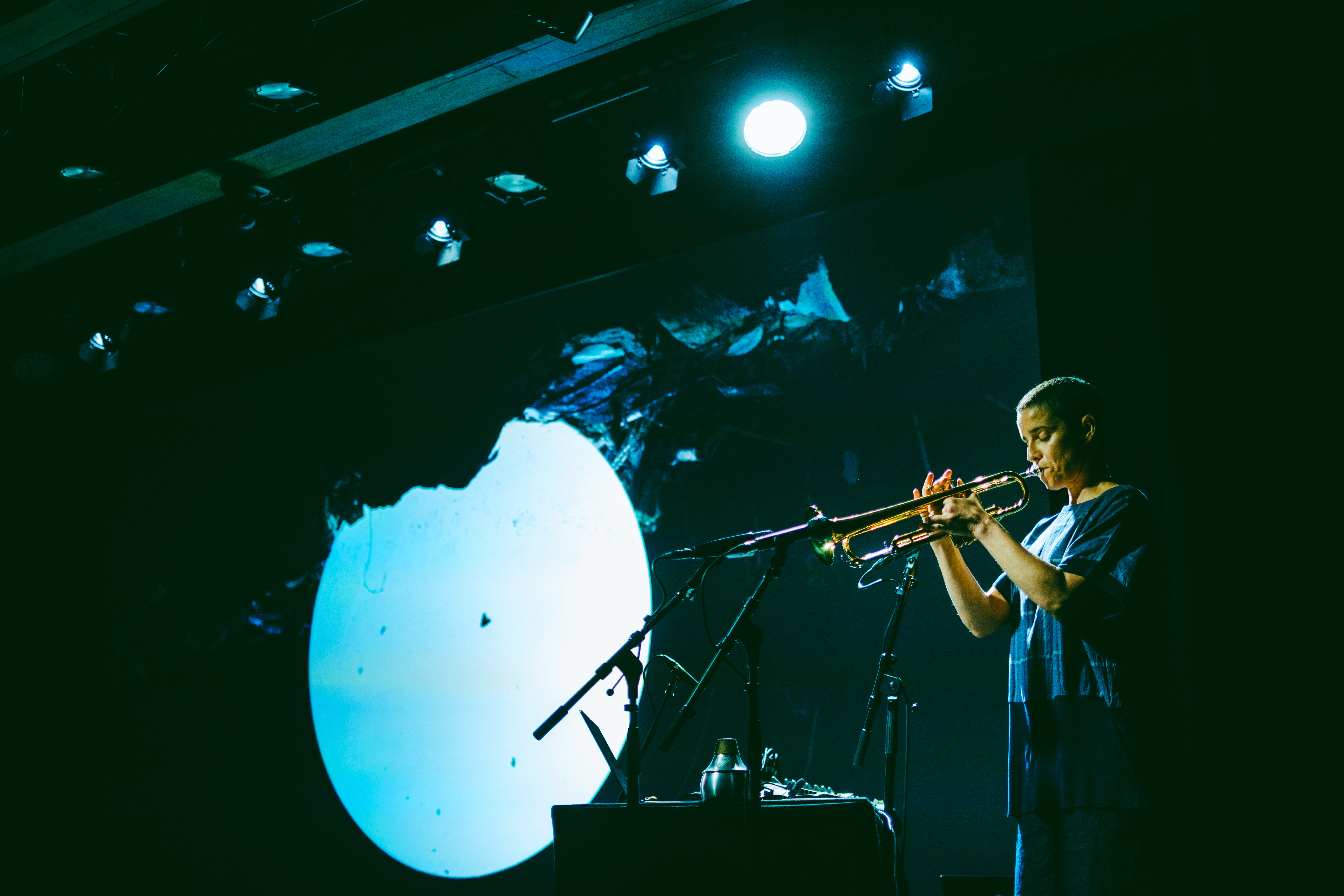
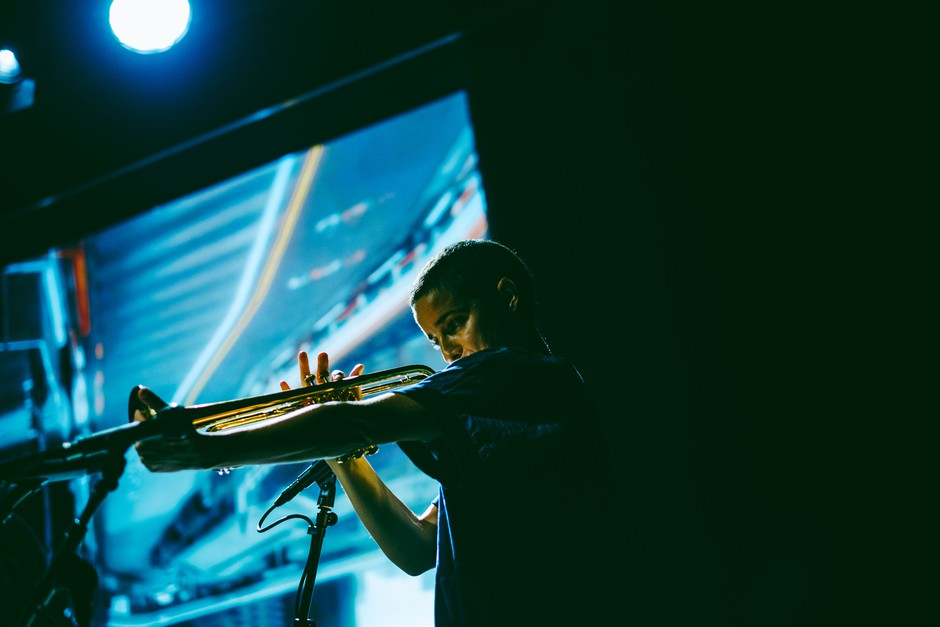
photos @ Vera Marmelo
 Susana Santos Silva